Cunning Riddles
Some riddles appear so simple that you’ll think you’ve solved them before you’ve even finished reading. That’s exactly what makes cunning riddles so entertaining—they lure you into making quick assumptions before revealing a clever twist that changes everything. These brain teasers reward patience, careful observation, and creative thinking rather than speed. Whether you’re challenging yourself, hosting a family game night, entertaining friends, or looking for a fun classroom activity, this collection of riddles will put your logic and problem-solving skills to the test. Read each one carefully and see if you can outsmart the hidden trick before checking the answer.
List of Cunning Riddles
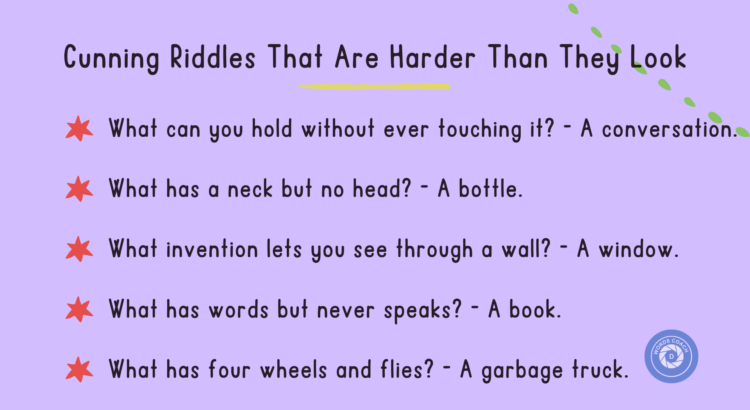
Riddle: What can you hold without ever touching it?
Answer: A conversation.
Riddle: The more you take from me, the larger I become. What am I?
Answer: A hole.
Riddle: What has one eye but can never see?
Answer: A needle.
Riddle: What can travel around the world while staying in the same place?
Answer: A stamp.
Riddle: A man was born in 1995 and died in 1990. How is that possible?
Answer: The room numbers in a hospital (he was born in Room 1995 and died in Room 1990).
Riddle: What belongs to you but everyone else uses more than you do?
Answer: Your name.
Riddle: Which month has 28 days?
Answer: All of them.
Riddle: What has many keys but can’t open a single lock?
Answer: A piano.
Riddle: What gets wetter the more it dries?
Answer: A towel.
Riddle: A plane crashes on the border of two countries. Where are the survivors buried?
Answer: They aren’t buried because they survived.
Riddle: What question can you never answer “yes” to honestly?
Answer: “Are you asleep?”
Riddle: What has a neck but no head?
Answer: A bottle.
Riddle: What invention lets you see through a wall?
Answer: A window.
Riddle: What comes down but never goes up?
Answer: Rain.
Riddle: What has branches but no trunk, fruit, or leaves?
Answer: A bank.
Riddle: What gets bigger every time you take something away?
Answer: A hole.
Riddle: What has a head, a tail, but no body?
Answer: A coin.
Riddle: A farmer has 20 sheep. All but 6 run away. How many sheep remain?
Answer: 6.
Riddle: What has words but never speaks?
Answer: A book.
Riddle: What has four wheels and flies?
Answer: A garbage truck.
Riddle: What starts with E, ends with E, and contains one letter?
Answer: An envelope.
Riddle: What has hands but can never clap?
Answer: A clock.
Riddle: What is so fragile that saying its name breaks it?
Answer: Silence.
Riddle: What can be broken without being touched?
Answer: A promise.
Riddle: What has cities but no houses, forests but no trees, and rivers but no water?
Answer: A map.
Riddle: If you pass the runner in second place, what place are you in?
Answer: Second place.
Riddle: What has many teeth but can’t bite?
Answer: A comb.
Riddle: What goes up but never comes down?
Answer: Your age.
Riddle: What has a bed but never sleeps?
Answer: A river.
Riddle: What can fill an entire room without taking up space?
Answer: Light.
Riddle: A rooster lays an egg on a rooftop. Which way does it roll?
Answer: Roosters don’t lay eggs.
Riddle: What can be caught but never thrown?
Answer: A cold.
Riddle: What is full of holes but still holds water?
Answer: A sponge.
Riddle: What has legs but never walks?
Answer: A table.
Riddle: Forward I am heavy, backward I am not. What am I?
Answer: The word “ton.”
Riddle: What comes once in a minute, twice in a moment, but never in a thousand years?
Answer: The letter M.
Riddle: A man shaves several times a day but still has a beard. Who is he?
Answer: A barber.
Riddle: What has a face but no eyes, nose, or mouth?
Answer: A clock.
Riddle: Which weighs more: 1 kilogram of cotton or 1 kilogram of iron?
Answer: They weigh exactly the same.
Riddle: What is always in front of you but can never be seen?
Answer: The future.
Riddle: What can disappear as soon as you say its name?
Answer: Silence.
Riddle: A man pushes his car to a hotel and suddenly knows he’s bankrupt. Why?
Answer: He’s playing Monopoly.
Riddle: What can run but never walks, has a mouth but never talks?
Answer: A river.
Riddle: What has one head, one foot, and four legs?
Answer: A bed.
Riddle: If five machines make five gadgets in five minutes, how long do 100 machines take to make 100 gadgets?
Answer: Five minutes.
Riddle: What starts with P, ends with E, and contains thousands of letters?
Answer: A post office.
Riddle: What can you always find at the end of a rainbow?
Answer: The letter W.
Riddle: What has no beginning, no end, and no middle?
Answer: A doughnut.
Riddle: I become shorter as I grow older. What am I?
Answer: A candle.
Riddle: The smarter you are, the more you realize you don’t know. What am I?
Answer: Knowledge.
Category Wise Cunning Riddles
Everyday Object Riddles
Riddle: What has keys but can’t open locks?
Answer: A piano.
Riddle: What gets wetter the more it dries?
Answer: A towel.
Riddle: What has hands but cannot clap?
Answer: A clock.
Riddle: What has one eye but cannot see?
Answer: A needle.
Riddle: What has many teeth but never bites?
Answer: A comb.
Riddle: What has a neck but no head?
Answer: A bottle.
Riddle: What has pages but isn’t a website?
Answer: A book.
Riddle: What has four wheels and flies?
Answer: A rubbish truck.
Riddle: What can fill a room but takes up no space?
Answer: Light.
Riddle: What has a ring but no finger?
Answer: A telephone.
Clever Wordplay Riddles
Riddle: What belongs to you but everyone else uses more?
Answer: Your name.
Riddle: What comes once in a minute, twice in a moment, but never in a thousand years?
Answer: The letter M.
Riddle: What starts with E, ends with E, and contains only one letter?
Answer: An envelope.
Riddle: What comes at the end of everything?
Answer: The letter G.
Riddle: What disappears as soon as you say its name?
Answer: Silence.
Riddle: What can be cracked, made, told, and played?
Answer: A joke.
Riddle: What has words but never speaks?
Answer: A dictionary.
Riddle: What can you keep after giving it away?
Answer: Your word.
Riddle: What has an answer but never asks a question?
Answer: A telephone.
Riddle: What travels around the world while staying in one corner?
Answer: A postage stamp.
Logic Challenge Riddles
Riddle: What gets bigger the more you take away?
Answer: A hole.
Riddle: Which month has 28 days?
Answer: Every month.
Riddle: What goes up but never comes down?
Answer: Your age.
Riddle: What comes down but never goes up?
Answer: Rain.
Riddle: What can you catch but never throw?
Answer: A cold.
Riddle: What can run but never walks?
Answer: Water.
Riddle: What flies without wings?
Answer: Time.
Riddle: What is always coming but never arrives?
Answer: Tomorrow.
Riddle: The more you take, the more you leave behind. What are they?
Answer: Footsteps.
Riddle: What can be broken without touching it?
Answer: A promise.
Mind-Bending Brain Teasers
Riddle: What has cities but no houses, rivers but no water, and forests but no trees?
Answer: A map.
Riddle: What building has the most stories?
Answer: A library.
Riddle: What has branches but no leaves?
Answer: A bank.
Riddle: What has one head, one foot, and four legs?
Answer: A bed.
Riddle: What kind of tree fits in your hand?
Answer: A palm.
Riddle: What has ears but cannot hear?
Answer: Corn.
Riddle: I shave every day, but my beard stays the same. Who am I?
Answer: A barber.
Riddle: What has an eye but no face?
Answer: A hurricane.
Riddle: What has four fingers and a thumb but isn’t alive?
Answer: A glove.
Riddle: What can never be put into a saucepan?
Answer: Its lid.
Ultimate Cunning Riddles
Riddle: What has roots nobody sees but is taller than trees?
Answer: A mountain.
Riddle: What can speak every language without saying a word?
Answer: An echo.
Riddle: What can you hold without touching it?
Answer: Your breath.
Riddle: What is easy to lift but difficult to throw?
Answer: A feather.
Riddle: What has no beginning, end, or middle?
Answer: A doughnut.
Riddle: What can be seen once in a year, twice in a week, but never in a day?
Answer: The letter E.
Riddle: Why was the mathematics book unhappy?
Answer: It had too many problems.
Riddle: What do you call fake spaghetti?
Answer: An impasta.
Riddle: Why did the bicycle fall over?
Answer: Because it was two-tired.
Riddle: What do you call a sleeping bull?
Answer: A bulldozer.
Riddle: Why don’t eggs tell jokes?
Answer: They might crack each other up.
Riddle: What do you call a bear with no teeth?
Answer: A gummy bear.
Riddle: Why did the tomato blush?
Answer: Because it saw the salad dressing.
Riddle: Why don’t elephants use computers?
Answer: They’re afraid of the mouse.
Riddle: What do frogs order at restaurants?
Answer: French flies.
Riddle: What did one wall say to the other?
Answer: I’ll meet you at the corner.
Riddle: What has an endless supply of letters but starts empty?
Answer: A mailbox.
Riddle: What has a face and two hands but no arms or legs?
Answer: A clock.
Riddle: What can be found in the middle of nowhere?
Answer: The letter H.
Riddle: What begins with one step and ends with a destination?
Answer: A journey.
The most satisfying riddles aren’t always the longest or most difficult—they’re the ones that quietly trick you into overlooking the obvious. These cunning riddles prove that careful thinking often beats quick guessing. Whether you solved every puzzle or found yourself surprised by a few clever twists, each challenge helped sharpen your observation and reasoning skills. Share this collection with friends, family, students, or coworkers and discover who can spot the hidden clues first. The more riddles you solve, the better you’ll become at thinking beyond the obvious.
Download Word Coach Application
FAQ’s
What are cunning riddles?
Cunning riddles are cleverly written brain teasers that use hidden clues, wordplay, or misleading wording to make simple questions surprisingly difficult to solve.
Why are these riddles harder than they look?
They encourage you to make quick assumptions. The real answer often depends on reading carefully, noticing subtle clues, and thinking creatively instead of choosing the obvious response.
Are these riddles suitable for children?
Yes. Most of these riddles are family-friendly and enjoyable for children, teenagers, and adults. Some of the trickier ones may require hints for younger readers.
Can solving riddles improve brain function?
Regularly solving riddles can strengthen logical reasoning, observation, memory, concentration, and creative problem-solving while providing an enjoyable mental workout.
Where can I use these riddles?
They’re perfect for classrooms, family game nights, road trips, quiz competitions, team-building activities, youth groups, parties, and social media engagement.