Academic Vocabulary for Essays
I remember sitting in my first university seminar, reading essays by my classmates and feeling something was off about my own writing. Their arguments didn’t necessarily seem more intelligent than mine. But there was a certain fluency — a confidence in how they moved between ideas — that I couldn’t quite put my finger on. Later, I realized it came down to vocabulary. Not fancy words for the sake of it, but the right words in the right places.
Academic writing has its own grammar of expression. Just like a carpenter has a specific name for each tool, academic writers have a precise vocabulary for signaling what they’re doing at each moment in an essay: introducing a claim, presenting evidence, acknowledging a counterargument, drawing a conclusion. Once you internalize that vocabulary, your writing doesn’t just sound better — it becomes clearer to you too.
Why vocabulary matters more than you think
There’s a common misconception that academic vocabulary is about impressing examiners. Use the word “paradigm” instead of “model,” throw in “hegemony” somewhere, and you’ll get better marks. That’s not how it works — and professors see through it immediately.
Real academic vocabulary is functional. Each phrase does a job. When you write “this essay will argue that,” you’re not decorating your introduction; you’re making a contract with the reader about what comes next. When you write “it could be countered that,” you’re not just padding a paragraph; you’re demonstrating that you’ve considered the other side, which is one of the hallmarks of rigorous thinking.
“The difference between the right word and the almost-right word is the difference between lightning and a lightning bug.” — Mark Twain
This is why building your academic vocabulary is one of the highest-return investments you can make as a student. It doesn’t just improve individual essays — it sharpens the way you think about arguments and evidence altogether.
The six pillars of essay vocabulary
Think about what an essay actually has to do. It has to state a position, support that position with evidence, engage with counterarguments, show how causes lead to effects, and arrive at conclusions. Each of these functions has its own vocabulary cluster. Mastering these six categories will give you the tools to write at almost any level of academic writing.
The first category is analysis vocabulary — words like “demonstrates,” “illustrates,” and “suggests” that you use when interpreting evidence. The second is argumentation — phrases for staking claims and building your case. Then there’s contrast and concession language, which shows intellectual honesty. Evidence vocabulary helps you introduce sources and data cleanly. Causation vocabulary lets you explain why things happen. And conclusion vocabulary signals to the reader that you’re wrapping up and pointing toward implications.
How to use this vocabulary without sounding robotic
The biggest danger with academic vocabulary lists is that students treat them as substitutes for thought. You can’t just sprinkle “it is evident that” into a paragraph and expect it to read like an argument. The phrase has to introduce something that genuinely follows from your evidence.
A useful rule of thumb: before you use any of these phrases, ask yourself what you’re actually trying to do at this moment in the essay. Am I introducing evidence? Challenging an assumption? Drawing a distinction? Once you know your purpose, the vocabulary will slot in naturally. It’s like a tennis player knowing they need a backhand — the technique follows the tactical intention.
Another thing worth noting: variety matters. Reading five consecutive sentences that all begin with “Furthermore” creates a numbing effect. Mix your connectives. Alternate between embedded citation phrases. Use short, direct sentences alongside longer analytical ones. The vocabulary in the table below is a toolkit — the skill is knowing when to reach for which tool.
A note on register and discipline
Academic vocabulary isn’t one-size-fits-all. A history essay has different conventions than a psychology lab report. In the sciences, you’ll rarely find “one might argue” — you’ll find passive constructions and precise technical terminology. In the humanities, hedging language (“it could be suggested,” “this appears to indicate”) is common and expected, because conclusions are rarely absolute.
Before adopting any phrase wholesale, read a few published papers or essays in your discipline and notice how they’re structured. Pay particular attention to how the author moves from evidence to interpretation — that transition is where most of the craft lives.
With that grounding in mind, here is a comprehensive reference table. These are not just decorative expressions — each one is a functional move in the game of academic argument. Learn them, use them with intention, and you’ll notice the difference within a few essays.
List of Academic Vocabulary for Essays
| Word | Meaning | Example Sentence |
|---|---|---|
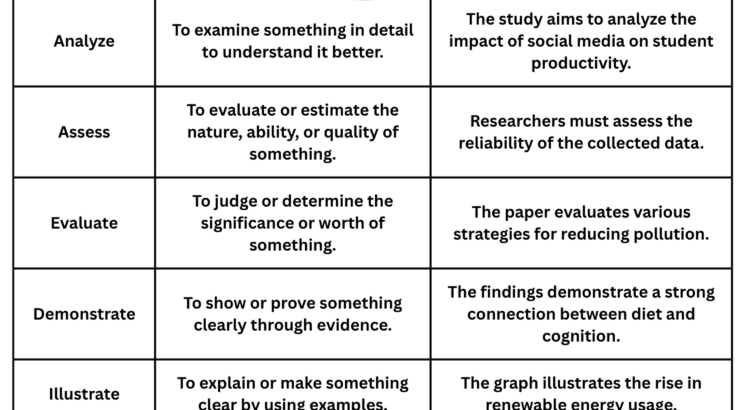
| Analyze | To examine something in detail to understand it better. | The study aims to analyze the impact of social media on student productivity. |
| Assess | To evaluate or estimate the nature, ability, or quality of something. | Researchers must assess the reliability of the collected data. |
| Evaluate | To judge or determine the significance or worth of something. | The paper evaluates various strategies for reducing pollution. |
| Demonstrate | To show or prove something clearly through evidence. | The findings demonstrate a strong connection between diet and cognition. |
| Illustrate | To explain or make something clear by using examples. | The graph illustrates the rise in renewable energy usage. |
| Interpret | To explain the meaning of something. | Scholars interpret the text as a critique of modern consumer culture. |
| Establish | To prove or show something to be true. | The report establishes a correlation between stress and sleep deprivation. |
| Emphasize | To give special importance to something. | The author emphasizes the need for early childhood education. |
| Highlight | To draw attention to something important. | The study highlights the economic consequences of climate change. |
| Indicate | To point out or suggest. | The results indicate that the new method is more effective. |
| Investigate | To examine systematically or thoroughly. | The research investigates the reasons behind declining voter turnout. |
| Justify | To explain why something is reasonable or necessary. | The author justifies the chosen methodology with strong evidence. |
| Summarize | To briefly state the main points. | The conclusion summarizes the major arguments presented in the essay. |
| Support | To provide evidence for an argument or claim. | Several studies support the idea that exercise improves mental health. |
| Refute | To prove something to be false or incorrect. | The paper refutes the claim that technology reduces human creativity. |
| Propose | To suggest an idea or plan. | The researchers propose a new framework for analyzing cultural trends. |
| Discuss | To present a detailed argument or examination. | The essay discusses the ethical implications of artificial intelligence. |
| Contrast | To highlight differences between two or more things. | The study contrasts rural and urban healthcare systems. |
| Compare | To identify similarities and differences. | The author compares two theories of human motivation. |
| Synthesize | To combine elements to form a coherent whole. | The conclusion synthesizes data from multiple sources. |
| Critique | To evaluate in a detailed and analytical way. | The paper critiques existing literature on gender inequality. |
| Define | To explain the exact meaning of a term. | The introduction defines key concepts used throughout the essay. |
| Imply | To suggest something indirectly. | The findings imply that economic reforms are overdue. |
| Acknowledge | To recognize the existence or validity of something. | The author acknowledges the limitations of the study. |
| Examine | To inspect or investigate closely. | The research examines the role of language in shaping identity. |
| Present | To show or introduce ideas or findings. | The report presents three possible solutions to the problem. |
| Outline | To give a general description or summary. | The author outlines the steps involved in the research process. |
| Clarify | To make something understandable. | The study clarifies the relationship between diet and mood. |
| Formulate | To create or devise methodically. | The researcher formulates a new hypothesis based on recent data. |
| Advocate | To publicly support a recommendation or idea. | The essay advocates for stronger environmental policies. |
| Demonstrates | Shows clearly through evidence or reasoning | The data demonstrates a consistent rise in literacy rates over the past two decades. |
| Illustrates | Clarifies or makes something visible through an example | This case illustrates the broader problem of income inequality in urban areas. |
| Suggests | Implies something without stating it directly | The pattern of results suggests a possible link between stress and sleep deprivation. |
| Reveals | Uncovers something previously hidden or unclear | The interview transcripts reveal a widespread sense of distrust among participants. |
| Highlights | Draws attention to a significant point or issue | The study highlights the gap between policy intention and practical implementation. |
| Underlines | Emphasizes the importance of something | This finding underlines the need for further investment in renewable energy. |
| Examines | Looks at something carefully and in detail | This essay examines the role of social media in shaping political opinion. |
| Explores | Investigates a topic or idea broadly | The research explores the relationship between childhood environment and adult outcomes. |
| It is argued that | Introduces a claim being made in the essay | It is argued that digital literacy has become as essential as traditional literacy. |
| This essay contends | States the essay’s central position | This essay contends that economic growth alone cannot address persistent poverty. |
| One might assert | Introduces a viewpoint with moderate confidence | One might assert that the policy failed to account for regional differences. |
| It is evident that | States something considered clearly true based on evidence | It is evident that the reforms had only a limited effect on public health outcomes. |
| Fundamentally | At the most basic or important level | The conflict is fundamentally about access to resources, not ideology. |
| Crucially | In a way that is decisive or very important | Crucially, the study controlled for socioeconomic variables, strengthening its conclusions. |
| Significantly | To a notable or important degree | The intervention significantly reduced hospital readmission rates. |
| Unequivocally | Without any doubt; in a completely clear way | The evidence unequivocally supports the hypothesis that diet influences cognition. |
| However | Introduces a contrast or qualification | The policy improved test scores; however, dropout rates remained unchanged. |
| Nevertheless | Despite what has just been said | The sample size was small; nevertheless, the results are consistent with larger studies. |
| It could be countered that | Introduces an opposing viewpoint | It could be countered that increased surveillance compromises individual privacy rights. |
| Conversely | Introduces the opposite point or situation | Urban areas saw economic growth; conversely, rural regions continued to decline. |
| While it is true that | Acknowledges a valid point before qualifying it | While it is true that economic growth occurred, inequality also widened during this period. |
| Notwithstanding | Despite the fact of something; in spite of | Notwithstanding the limitations of the data, the conclusions remain plausible. |
| On the other hand | Presents an alternative perspective | Stricter regulation may reduce risk; on the other hand, it could stifle innovation. |
| Admittedly | Conceding a point that weakens one’s argument | Admittedly, correlation does not imply causation in this context. |
| According to | Introduces information from a specific source | According to Smith (2019), urban migration accelerated after the industrial reforms. |
| As evidenced by | Supported by specific evidence | As evidenced by the survey results, public trust in institutions has declined. |
| This is supported by | Points to evidence that confirms a claim | This is supported by a meta-analysis of over 40 studies on dietary behaviour. |
| Empirical data suggests | Data from observation or experiment points to a conclusion | Empirical data suggests that early intervention significantly improves long-term outcomes. |
| Cites | Refers to a source or authority | The report cites declining birth rates as a key driver of labour shortages. |
| Drawing on | Using as a source or basis | Drawing on a decade of longitudinal research, the authors challenge previous assumptions. |
| Corroborates | Confirms or gives support to a claim | This finding corroborates earlier research conducted in Scandinavian countries. |
| As demonstrated by | Shown clearly through an example or data | As demonstrated by the case of Finland, early childhood education yields lasting benefits. |
| Consequently | As a result; used to show effect | The factory closed; consequently, unemployment in the region rose sharply. |
| Therefore | For that reason; shows logical conclusion | The experiment produced no significant results; therefore, the hypothesis was rejected. |
| This leads to | Causes or results in something | Chronic underfunding of public services this leads to long-term social inequality. |
| As a result | Because of this; shows consequence | Temperatures rose significantly; as a result, crop yields fell by 30 per cent. |
| Stems from | Originates from or is caused by | The distrust largely stems from decades of political mismanagement. |
| Gives rise to | Causes something to happen or develop | Rapid urbanisation gives rise to new forms of social stratification. |
| Is attributable to | Can be explained by a particular cause | The improvement is attributable to targeted investment in teacher training. |
| Thus | Therefore; as a logical consequence | The controls were inadequate; thus, the reliability of the findings is questionable. |
| In conclusion | Signals the final summary of an argument | In conclusion, the evidence strongly supports a move toward decentralised governance. |
| In summary | Briefly restates the main points made | In summary, three key factors account for the policy’s failure. |
| Ultimately | In the end; considering the most important point | Ultimately, the success of the reform depends on sustained political will. |
| To conclude | To finish and draw together the argument | To conclude, the findings suggest a need for a more integrated policy approach. |
| This essay has argued | Summarises the central claim made throughout | This essay has argued that language shapes, rather than merely reflects, social reality. |
| These findings indicate | The results point to a particular conclusion | These findings indicate that early nutrition has a measurable impact on cognitive development. |
| It is clear that | States a conclusion as well-established | It is clear that a single-policy approach is insufficient to address systemic poverty. |
| Further research is needed | More investigation is required before conclusions are definitive | Further research is needed to determine the long-term effects of this intervention. |
| The implications of this are | Points to what the findings mean in a wider context | The implications of this are significant for public health policy across the region. |
| This contributes to | Adds to a broader body of knowledge or debate | This study contributes to our understanding of how poverty shapes educational aspiration. |